Ask a room of parents what they hope high school gives their daughter, and leadership will likely come up often. They want her to speak up in a meeting someday. They want her to run the project instead of waiting to be assigned a part of it. What gets less attention is the practice it takes to get there. Nobody leads well the first time they try, so your daughter needs chances to do it while the stakes are small, and she can get it wrong without it mattering much.
An all-girls education changes how many of those opportunities she gets, and it changes who she’s competing with.
Every leadership role is held by a girl
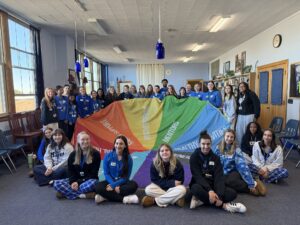
At an all-girls school, girls hold 100% of the leadership roles. The student council president is a girl. So is the captain of every team, and so is the student who runs the club meeting after school. The lead in the Fall musical is a girl, and the student managing the stage crew behind her is one, too.
That doesn’t mean every student becomes president. It means the line of students ahead of her looks different. A 9th grader at Mt. St. Mary Academy watches seniors run assemblies and plan Spirit Week, and every one of those seniors is a young woman. Leading looks like a normal thing girls do, because she watches young women do it every week of the school year.
Graduates notice the difference when they look back, too. Goodman Research Group surveyed young alumnae of single-sex schools for The Girls’ School Experience, and 93% said they were offered greater leadership opportunities than their peers at coed schools. 80% had held leadership positions since graduating from high school.
Confidence comes from practice
Confidence gets talked about as if it’s a trait a young woman either has or doesn’t. In practice, it behaves more like a skill, and skills grow with repetition. A student who has run a meeting 20 times walks into the next one calmer than a student doing it for the first time, and she recovers faster when a decision doesn’t land the way she hoped.
Public speaking follows the same pattern, and it’s the part of leading that people notice first. Researchers at UCLA’s Higher Education Research Institute compared women entering college from single-sex and coeducational independent schools, and 45% of the single-sex graduates rated their public speaking ability above average or in the highest 10%. Among their coeducational peers, the figure was just 39%.
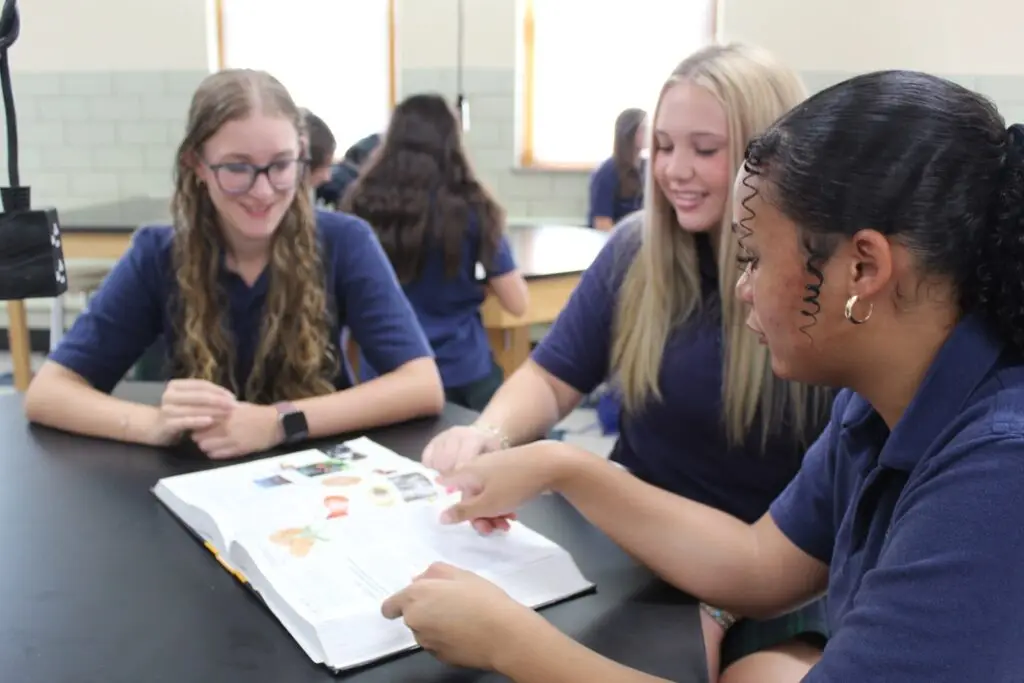
Practicing in an all-girls room lowers the social cost of a rough first attempt. Your daughter can give a shaky first speech, take the feedback, and give a better one the following month. Trying and getting it wrong in public carries less weight when everybody around her is doing the same thing. Over four years, that builds a record she can grow from: times she led and it went well, and times it didn’t and she adjusted. Confidence built on a record like that tends to hold steady, because it doesn’t depend on one good day.
Long Lasting Effects
Most studies of girls’ schools compare students who chose their schools, which leaves an obvious question. Did the school build the leader, or did families with leadership in mind pick the school? A study published in 2025 worked around that problem. For decades, Seoul, South Korea assigned students to high schools by lottery. Researchers could then compare women who landed in single-sex schools with women who landed in coeducational ones, and the only reason one group ended up where it did was chance.
Lee and Sambanis, the researchers behind that study, were asking a straightforward question: does the kind of high school a girl attends leave any mark on her adult life? They surveyed 3,441 adults who had graduated between 1990 and 2010. The women who attended single-sex schools were 7.3 percentage points more likely to have held a leadership position in a group or organization as adults, and they took part in civic and political life at higher rates as well. The researchers found the effects lasted for years after graduation, in many cases decades. Their explanation is that in a single-sex school, girls are the strongest students and the class president, so every student grows up seeing girls hold those jobs.
Her first job
When your daughter sits in her first job interview and gets asked about a time she led something, a young woman who spent four years in an all-girls school has real experience. She’s run the meeting and captained the team. She’s organized people her own age, and answered for how it turned out.
Women at the top of companies describe exactly that kind of start. EY and espnW surveyed more than 400 female executives around the world, and 94% of the women in C-suite roles had played sports. About three-quarters of the executives surveyed agreed that a background in sport can help accelerate a woman’s leadership and career potential. Deloitte found something similar in a 2023 survey of 1,100 women in the United States: 85% of the women who played sports said the skills they developed were important to their success at work, and among women in leadership roles, the figure was 91%.
At an all-girls school, every team captain is a girl, and the same goes for every other job that teaches a student to lead.
None of this requires a girl to be a natural leader. It requires practice. An all-girls school simply gives her more of it. Every leadership role is open to her, and the students she watches filling those roles are young women. The research says the habit lasts, too, showing up years later in college classrooms and in first jobs. So when parents say they hope their daughter will speak up in a meeting someday and run the project instead of waiting to be assigned a part of it, that hope has a practical side. It starts with a small job in ninth grade, and four years of opportunities to build upon it.
Sources
Goodman Research Group, The Girls’ School Experience: A Survey of Young Alumnae of Single-Sex Schools. The 93 percent and 80 percent figures are reported in the International Coalition of Girls’ Schools “Girls’ School Advantage” materials. https://girlsschools.org
Sax, L.J., Arms, E., Woodruff, M., Riggers, T., & Eagan, K. (2009). Women Graduates of Single-Sex and Coeducational High Schools: Differences in their Characteristics and the Transition to College. Higher Education Research Institute, UCLA. Public speaking self-ratings for the independent school sector: 45 percent (single-sex) vs. 39 percent (coeducational).
Lee, J., & Sambanis, N. (2025). “Same-Sex Schooling, Political Participation, and Gender Attitudes? Evidence from a Natural Experiment in South Korea.” Journal of Experimental Political Science, Cambridge University Press. Survey of 3,441 adults; graduates surveyed had finished high school between 1990 and 2010 under Seoul’s lottery assignment. https://resolve-he.cambridge.org/core/journals/journal-of-experimental-political-science/article/samesex-schooling-political-participation-and-gender-attitudes-evidence-from-a-natural-experiment-in-south-korea/85086C3457565A493369148C33B20BE7
EY Women Athletes Business Network & espnW (2015). Making the Connection: Women, Sport and Leadership. Survey of more than 400 women executives worldwide; 94 percent of C-suite respondents had played sports, and 74 percent agreed a sports background can help accelerate a woman’s leadership and career potential.
Deloitte (2023). Impact of Sports on Women’s Professional Success. Online survey of 1,100 U.S. women, August 2023; 85 percent of respondents who played sports said the skills were important to their professional success, rising to 91 percent among women in leadership roles. https://www.deloitte.com/us/en/about/press-room/new-deloitte-tv-spots-turn-the-tables-on-fandom-as-survey-reveals-girls-who-play-sports-are-likely-to-have-successful-careers.html