Have you ever really looked at the cast list for a typical high school play or musical? If you have, you’ve probably noticed what we think is a frustrating problem.
Walk into almost any co-ed high school auditorium on audition day, and you’ll usually find a sea of talented teenage girls outnumbering the boys by a landslide. Yet, if you crack open the scripts for the most popular classic plays and musicals, the character lists tell a completely different story. According to data from major theatrical licensing agencies, traditional scripts frequently feature a two-to-one—or even three-to-one—ratio of male to female characters.
The result? Dozens of incredibly talented girls end up fighting for just two or three female roles. And to make matters worse, those roles are often pretty one-dimensional. You’ve got the romantic interest, the polite sidekick, or the classic “damsel in distress.” It’s not exactly a recipe for stretching your creative wings.
But what happens when you completely remove that problem from the equation?
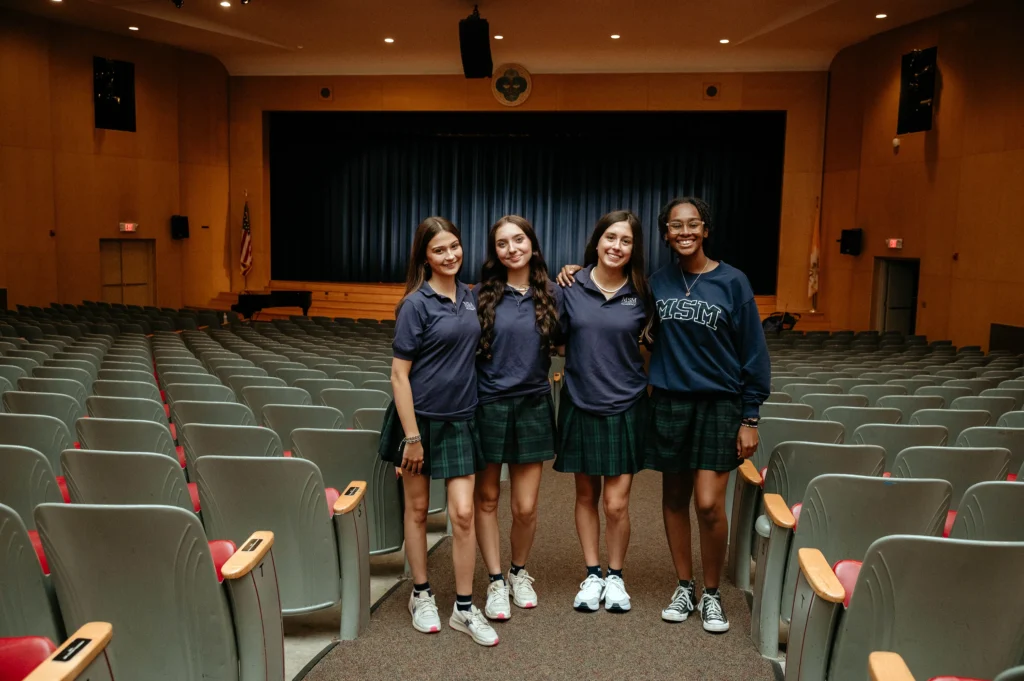
At an all-girls school, like Mount St. Mary Academy, the script literally flips. Because our students aren’t competing against boys for a limited handful of “female” roles, the entire canon of theatrical literature opens up to them. On our stage, the girls play every character. Sure, they’re the romantic leads and the ensemble members, but they’re also the swashbuckling heroes, the complicated villains, the aging kings, and the loud, physical comedians.
There’s an incredible, often overlooked psychological benefit to this kind of unrestricted casting. Think about it: high school is a time when teenagers are desperately trying to figure out who they are. Society often tries to box young women into being “polite,” “quiet,” or “agreeable.” Theater is supposed to be the one place where you get to step outside of yourself and break those rules. But if you’re only ever cast as the sweet ingenue, you aren’t really getting the chance to stretch your empathy muscle.
When a teenage girl is handed the role of a power-hungry monarch or a boisterous, loud-mouthed comedic foil, she’s given permission to explore facets of the human experience that girls are rarely encouraged to express. She has to learn how to walk into a room and command absolute authority. She has to learn how to use her voice to intimidate, to persuade, or to pull a roaring laugh from a crowd of hundreds of people.
It’s about so much more than just putting on a fun show for the parents on a Friday night. It’s an immersive study in human behavior. By stepping into shoes that were historically written for men, our students realize that leadership, complexity, ambition, and humor aren’t traits that belong to just one gender.
And this theatrical freedom translates directly to the real world, too. The student who figures out how to project the booming, unquestionable confidence of a Shakespearean general on stage at The Mount is the exact same student who will later walk into a daunting college seminar or a corporate boardroom and refuse to shrink herself.
We firmly believe that young women shouldn’t have to limit their imaginations to the roles society—or classic literature—traditionally carved out for them. At The Mount, we give them the stage, the script, and the absolute freedom to play whatever part they choose. Curtains Up!