
If you think back to your own middle school years, you probably remember a whirlwind of changes. Friend groups shifted overnight, maybe you got braces, and the pressure to fit in suddenly felt heavier than a backpack full of textbooks.
It’s a chaotic time of life for any teenager. But for young women, there’s often a hidden cost tucked away amid all that transition: their interest in science and math.
We see it happen all the time in traditional educational settings. A bright, curious fifth grader who loves building things and asking “why” suddenly turns into an eighth grader who sits quietly in the back of the algebra classroom, avoiding eye contact with the teacher.
This drop-off isn’t just an anecdotal observation; it’s a documented national trend. According to a comprehensive study conducted by Microsoft, girls’ interest in STEM (Science, Technology, Engineering, and Math) subjects actually peaks around age 11. But by the time they hit age 15, that interest plummets significantly.
So, what exactly happens between 6th and 10th grade?
Researchers point to a few key culprits, but a massive one is social pressure. In many coed middle and high schools, being the “smart math girl” isn’t always socially rewarded. There’s a subtle, often unspoken pressure to downplay intelligence to appear more approachable or to fit in with peers. Girls start worrying about how they look while doing the work, rather than focusing on the work itself. When a science lab requires getting messy or a math problem requires stepping up to the whiteboard and potentially making a very public mistake, many girls simply opt out.
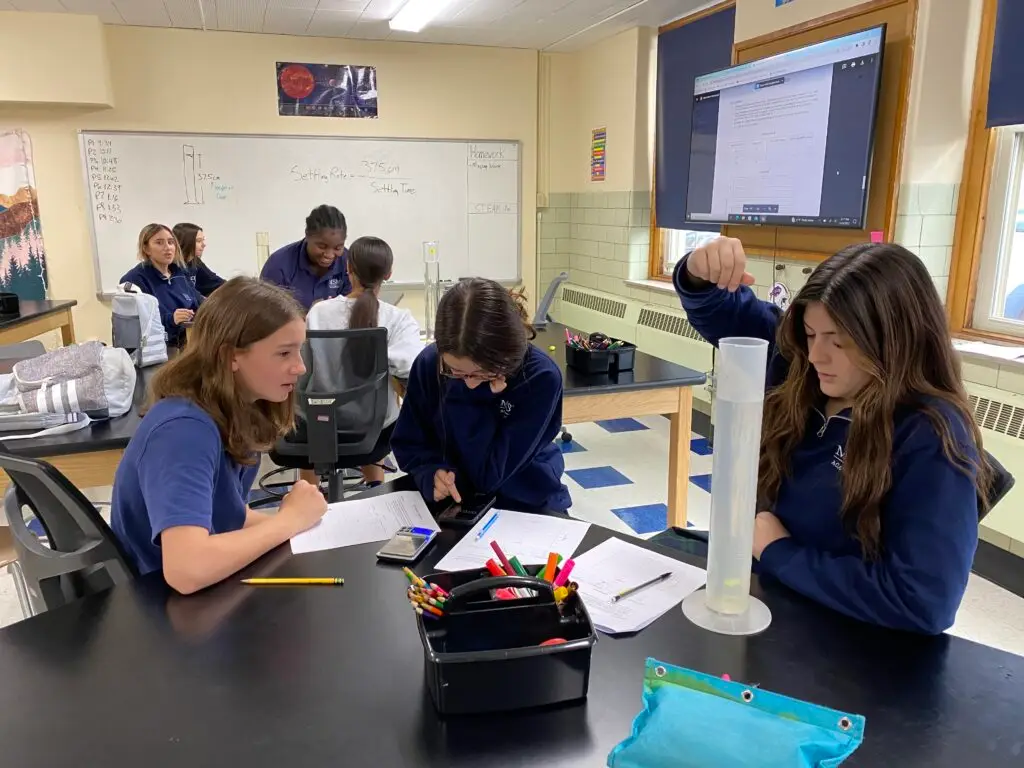
At Mount St. Mary Academy, we consider it our job to completely dismantle that middle school drop-off. We purposefully design our environment to catch girls right when society tells them to step back, and we encourage them to lean in instead.
Here’s how an all-girls environment rewrites the script on STEM engagement:
- Intelligence is the baseline: When you remove the mixed-gender social dynamics, the pressure to “hide your smarts” practically vanishes. At the Mount, being enthusiastic about a biology project or starting a coding club isn’t considered nerdy. It’s just considered normal.
- No one else will do the heavy lifting: In a typical coed physics or chemistry lab, it’s incredibly common for boys to take over the physical equipment—the beakers, the robotics kits, the power supplies—while girls default to the role of scribe, quietly taking notes. Here, there are no boys to hand the tools to. If a circuit needs to be wired, someone wires it. No one thinks twice about hands-on participation, building undeniable competence.
- Productive failure is celebrated: Math and science require trial and error. You have to be willing to get the wrong answer a few times before you find the right one. Our classrooms are safe zones for getting things wrong. Girls learn that a failed hypothesis isn’t a social embarrassment; it’s just the first step of the scientific method.
You can actually see the results of this culture shift in the numbers. Data provided by the National Coalition of Girls’ Schools shows that graduates of all-girls schools are six times more likely to consider majoring in math, science, and technology compared to girls who attend coed schools.
We don’t believe that girls suddenly lose their natural curiosity when they turn 13. They just start navigating an environment that makes it harder to express it. By removing those social hurdles, we make sure that the middle school girl who loves to build and question gets to grow into a high school senior who is ready to engineer the future.